


Occlusion

Treatment of dental occlusion (occlusal therapy), bite adjustment
What is dental occlusion? Dental occlusion is the way the upper and lower teeth contact each other during chewing, speaking, and swallowing. It is one of the most important elements of dental health because any irregularity in the bite can lead to a series of problems—from premature tooth wear to jaw and joint pain. When occlusion is correct, the load is distributed evenly, and the teeth, muscles, and joints work harmoniously. However, if malocclusion (an improper bite) is present, forces are concentrated on specific teeth or areas, leading to overloading, pain, and functional disorders.
Symptoms of dental occlusion problems
Bite disorders do not always manifest solely as toothache. Many patients present with complaints that, at first glance, are not related to the teeth. Headaches, tension in the neck and shoulders, and clicking or popping in the jaw are often signs of an occlusal problem. Even grinding teeth at night (bruxism) is directly related to the improper fit of the dental arches. If these symptoms are ignored, they can worsen and lead to serious joint or periodontal diseases.
Causes of malocclusion
The causes of an improper bite are varied and often combined. In some patients, malocclusion is hereditary and due to a disproportion in the development of the upper and lower jaws. In others, it is the result of tooth loss that was not restored in time, leading to the shifting of the remaining teeth and a disruption of balance. Improperly fabricated fillings and crowns can also lead to the overloading of individual teeth. Habits such as clenching teeth during stress or night grinding further aggravate the condition.
Types of Dental Occlusion
Class I – Normal Bite with Aesthetic Discrepancies
Class I is the closest to correct occlusion. In this type of bite, the lower and upper jaws are in a harmonious relationship, and the teeth make normal contacts. Functionally, this class is considered balanced and stable. Nevertheless, patients often have local issues such as crowding, rotated tooth crowns, or the presence of spaces (tremas and diastemas). These irregularities do not lead to significant functional difficulties but can create aesthetic concerns or hygiene challenges.
Treatment for Class I is most often orthodontic—using braces or clear aligners, which align the teeth and ensure a beautiful smile. It is important to emphasize that in Class I, therapy is more straightforward because the bite is functionally stable.
Class II – Deep Bite with Functional Complications
Class II is characterized by the lower teeth biting significantly further back than the upper ones. This can be the result of an underdeveloped lower jaw, an overdeveloped upper jaw, or a combination of both. Characteristic signs are observed in this type of malocclusion: the upper front teeth often protrude forward, the profile shows a pronounced retrusion of the chin, and patients are at a higher risk of incisor trauma. In addition to aesthetic changes, functional difficulties also arise—pain in the jaw joint, rapid tooth wear, difficulty chewing, and increased muscle tension.
The treatment of Class II depends on the severity and the age of the patient. In children, the best results are achieved through orthodontic appliances that stimulate the growth of the lower jaw. In adults, braces or aligners are usually applied in combination with fixed appliances, and in severe cases, orthognathic surgery may be necessary. The earlier therapy begins, the more effective and less invasive it is.
Class III – Underbite and Displaced Chin
Class III represents a condition where the lower teeth bite in front of the upper ones—this is known as an underbite. Usually, the cause is an underdeveloped upper jaw, an overdeveloped lower jaw, or a combination of both. The facial profile in Class III is characteristic—the chin is protruded forward, and the bite creates difficulties in chewing and speech. Furthermore, patients often suffer from chronic mouth breathing, halitosis, and functional joint problems.
This is the rarest but also the most difficult class of malocclusion to treat. Ideally, the problem is detected in childhood while the jaws are still growing, at which point it can be corrected with orthodontic appliances. In adults, treatment is significantly more complex and in many cases involves a combined approach—orthodontics plus surgical intervention. Nevertheless, therapy is possible even for mature patients and can improve both function and appearance.
Diagnosis of Occlusal Problems
Correct diagnosis is the key to successful treatment. In my practice, I use a combination of clinical analysis and modern instrumental methods. The examination includes an assessment of facial symmetry, jaw movement, and tooth contact during various movements. With the help of digital technologies, the distribution of masticatory forces can be measured. X-ray and 3D studies provide information about the bone structure, while electromyography shows muscle tension. All these data are combined to establish an accurate diagnosis and build an individual treatment plan.
Methods for treating dental occlusion
Occlusal Balancing and Selective Grinding
In milder cases, selective grinding of certain contact surfaces can be performed. This is a conservative procedure where minimal discrepancies are removed to ensure an even fit of the teeth. This method often brings immediate relief and prevents future complications.
Occlusal Splints (Splint Therapy)
When a patient suffers from teeth grinding or muscle and joint pain, I often recommend occlusal splints. These are worn primarily at night and protect the teeth from wear while simultaneously relaxing the muscles and reducing pressure on the joints.
Prosthetic Rehabilitation
For patients with serious occlusal problems and worn teeth, restoration with new crowns, bridges, or veneers is necessary. Here, the correct modeling of the occlusion is key to ensuring balance and long-term stability.
Orthodontic Treatment
Braces and clear aligners are the gold standard for more severe cases of malocclusion. They align the teeth gradually and create a functional and aesthetic bite. The treatment takes time, but the result is lasting and achieves not only aligned teeth but also the optimal functioning of the entire system.
Malocclusion: What Is It and How Does It Develop?
Malocclusion is the medical term for the improper alignment of teeth or a discrepancy between the upper and lower jaws when biting. Ideally, teeth contact evenly, ensuring effective chewing, clear speech, and an even distribution of masticatory forces. When this balance is disrupted, functional and aesthetic problems arise that affect overall dental health.
Causes of Malocclusion
Malocclusion occurs due to a combination of hereditary and acquired factors. Genetics are often decisive—the structure of the jaws, the size and shape of the teeth, as well as hereditary bite characteristics. On the other hand, acquired factors include habits such as prolonged thumb sucking, pacifier use beyond early childhood, mouth breathing, improper tongue positioning, or nail-biting. Losing baby teeth too early or too late, trauma, and improperly placed fillings or crowns can also lead to malocclusion.
Symptoms and Consequences
Malocclusion often goes unnoticed in the early stages. Gradually, however, the patient may begin to experience difficulty chewing, jaw pain, frequent headaches, muscle tension, or changes in speech. The consequences are not only aesthetic—an improper bite can lead to accelerated tooth wear, gum inflammation, bruxism, and even problems with the jaw joint.
Most Common Types of Malocclusion
-
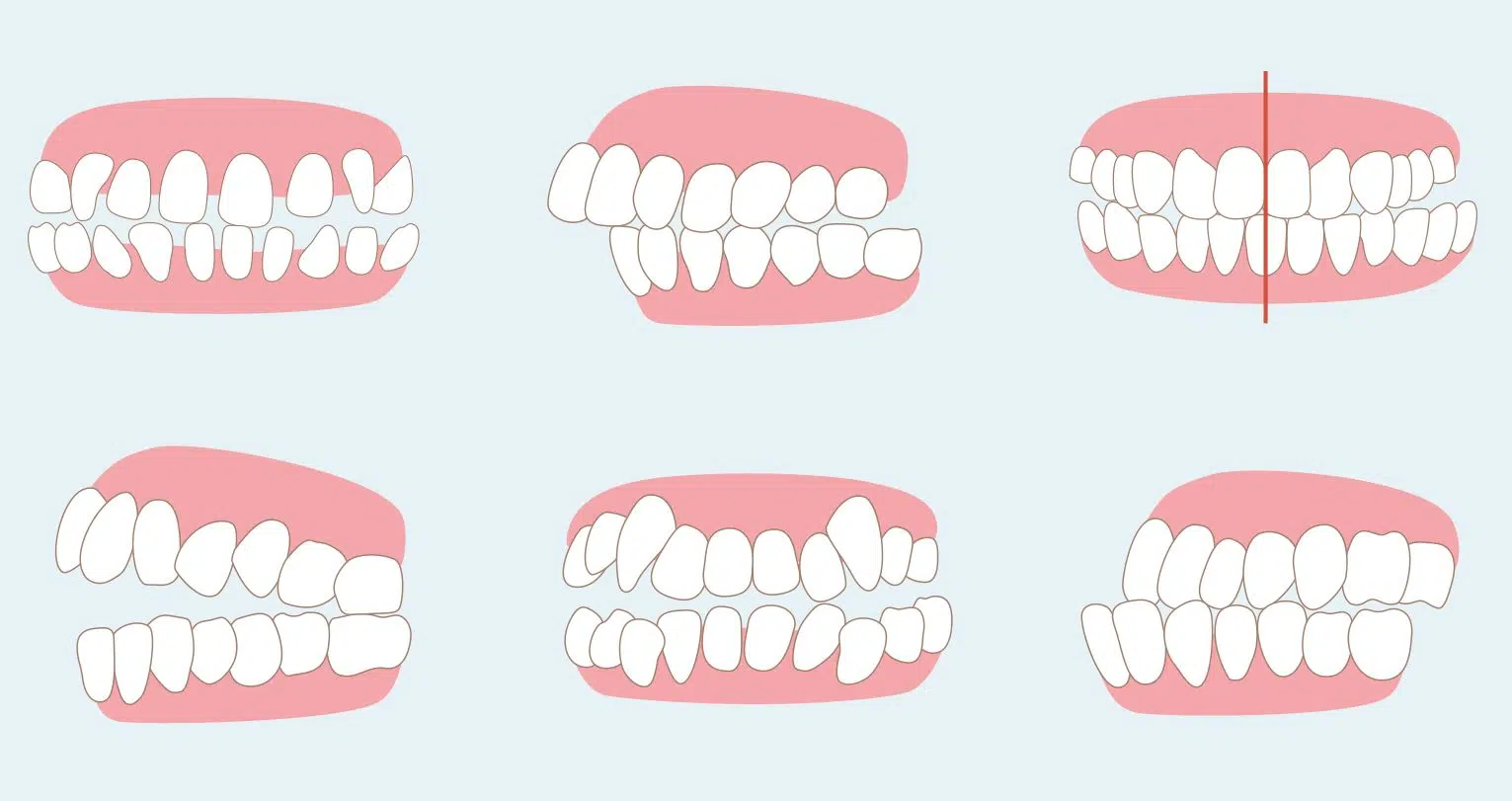
Deep bite (overbite) – the upper teeth excessively cover the lower ones, which can cause wear and gum irritation.
-
Open bite – the presence of a space between the upper and lower front teeth, which makes speaking and chewing difficult.
-
Crossbite – some of the upper teeth are positioned inside relative to the lower ones, creating uneven loading.
-
Prognathism – an excessively protruding upper or lower jaw, associated with impaired function and aesthetics.
-
Crowding – a lack of sufficient space in the jaw, leading to rotations and overlapping.
-
Diastema – the presence of spaces between the teeth, which affect aesthetics and pronunciation.
Why is Malocclusion Treatment Important?
Malocclusion is not just “crooked teeth.” It is a serious factor in the overloading of jaw joints, tooth wear, periodontal diseases, and chronic pain. Timely diagnosis and treatment—through orthodontics, occlusal splints, or prosthetic rehabilitation—can prevent complications and restore the normal function of the masticatory apparatus.
Dental Occlusion and Its Relationship to Periodontitis
An improper bite often aggravates periodontal diseases. When certain teeth take on the majority of the load, they begin to loosen. This intensifies inflammation and accelerates tooth loss. For patients with periodontitis, I always pay special attention to occlusion because balancing it can stop the progression of the disease and extend the life of the teeth. In some cases, I combine occlusal therapy with laser periodontal treatment, which is gentle and effective.
