


Removable Dentures
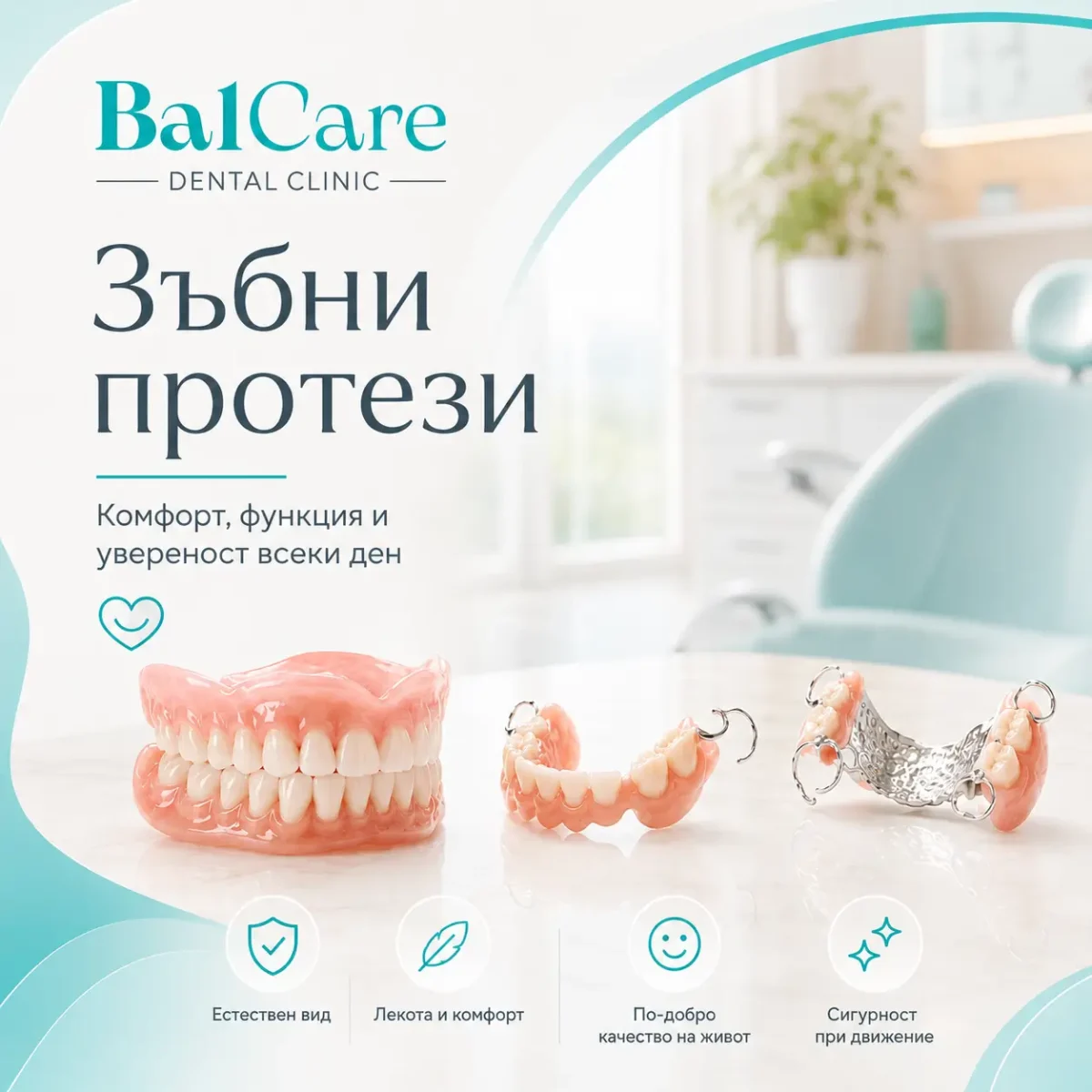
Removable Dentures – Restoring Your Smile and Chewing Function
Tooth loss is not only an aesthetic concern. It can make eating and speaking more difficult, change the way chewing forces are distributed, and affect a patient’s confidence.
Removable dentures are custom-made dental appliances designed to replace some or all missing teeth. They can be removed and reinserted by the patient and are made according to the individual anatomy of the jaw, the remaining natural teeth, the bite, and the condition of the gums.
At BalCare Dental Clinic, every case is assessed individually because there is no universal denture solution that is suitable for every patient.
When Are Removable Dentures Recommended?
A removable denture may be an appropriate solution in cases of:
- complete tooth loss in one or both jaws;
- inability or unwillingness to undergo dental implant treatment;
- situations in which a fixed dental bridge cannot be made;
- the need for a temporary restoration following tooth extraction;
- the need to improve chewing, speech, and aesthetics.
The final choice is made after a dental examination and assessment of the jawbone, oral mucosa, remaining teeth, gums, and the way the upper and lower jaws come into contact.
ThermoSens Dentures – Greater Comfort, Natural Appearance, and Durability
ThermoSens dentures, also commonly referred to by patients as “soft” or “silicone” dentures, are made from a modern thermoplastic polyamide material.
They have been developed as an alternative to traditional acrylic dentures and may be preferred by patients looking for a lighter feel, a more discreet appearance, and good durability in everyday use.
The material has a certain degree of flexibility, allowing the denture to adapt closely to the individual shape of the gums and oral cavity. This can provide a more comfortable feeling during wear and greater comfort when speaking and eating.
What Are the Benefits for the Patient?
Greater Everyday Comfort
Compared with some conventional rigid acrylic dentures, ThermoSens dentures may feel lighter and more comfortable.
The material allows for a finer construction that follows the contours of the oral mucosa and the individual anatomy of the jaw.
A properly made denture can support:
- more confident chewing;
- easier pronunciation of words;
- a reduced feeling of bulkiness in the mouth;
- faster adaptation to the new denture.
Comfort also depends on the accuracy of the fit, the condition of the gums, and regular follow-up examinations.
A Natural-Looking Smile Without Visible Metal Clasps
One of the most sought-after advantages of partial ThermoSens dentures is the possibility of making the retentive elements from the same material as the denture base.
This can help avoid the visible metal clasps associated with some conventional partial dentures. The colour of the material can be selected to closely resemble the natural shade of the gums or teeth.
The result is a more discreet denture that is less noticeable when:
- smiling;
- speaking;
- eating;
- being photographed or interacting closely with other people.
High Durability in Everyday Use
ThermoSens is a material with good resistance to impact and fracture.
Thanks to its flexibility, the risk of damage during normal eating or accidental dropping may be lower compared with some traditional acrylic dentures.
This does not mean that the denture is completely unbreakable. It still needs to be handled and cleaned carefully, but it may be a suitable option for patients who are concerned about their denture breaking easily.
No Residual Acrylic Monomer
ThermoSens material does not contain residual acrylic monomer, which may be present in some conventional acrylic materials.
For this reason, the denture may be considered as an alternative for patients who:
- have sensitive oral mucosa;
- experience discomfort with conventional acrylic dentures;
- have a confirmed intolerance to certain acrylic components;
- are looking for a denture made from a material without residual monomer.
If an allergy or intolerance is suspected, prior consultation is necessary.
It would not be accurate to describe any material as completely “hypoallergenic” for every patient, as an individual reaction may occur with almost any medical material.
Smooth Surface and Easy Maintenance
When properly fabricated and polished, a ThermoSens denture has a smooth surface that facilitates daily cleaning.
The material is resistant to moisture in the oral cavity and, with good hygiene, can maintain its properties and appearance.
To minimise the accumulation of plaque, odours, and stains, it is important to clean the denture every day using appropriate products.
The following should not be used:
- boiling or very hot water;
- abrasive toothpastes or cleaning products;
- hard brushes;
- bleach or aggressive cleaning agents;
- self-adjustment, bending, or filing of the denture.
Who Are ThermoSens Dentures Suitable For?
This type of denture may be appropriate in cases of:
- one or more missing teeth;
- the need for a partial removable denture;
- complete tooth loss under suitable clinical conditions;
- preference for a more discreet restoration without visible metal clasps;
- sensitivity to conventional acrylic materials;
- the need for a denture with greater resistance to fracture;
- inability or unwillingness to undergo implant treatment;
- preference for a lighter and more comfortable removable restoration.
ThermoSens is not a universal solution for every patient.
The most appropriate type of denture is determined after an examination of the gums, jawbone, bite, and remaining natural teeth.
ThermoSens or a Conventional Acrylic Denture?
| Feature | Conventional Acrylic Denture | ThermoSens Denture |
|---|---|---|
| Material | Rigid acrylic resin | Thermoplastic polyamide |
| Feel during wear | More rigid construction | Finer construction with a certain degree of flexibility |
| Retentive elements | Metal clasps may be used | Clasps can be made in a shade close to the gums |
| Aesthetics | Good, although clasps may sometimes be visible | More discreet appearance in partial dentures |
| Resistance to accidental dropping | Fracture may occur | High impact resistance |
| Residual acrylic monomer | May be present depending on the material and manufacturing process | Does not contain residual acrylic monomer |
| Suitability for patients with sensitivity | Assessed individually | May be considered as an alternative after consultation |
| Comfort | Depends on design and fit | May provide a lighter and more adaptable feel |
Complete Acrylic Dentures
A complete acrylic denture replaces all teeth in the upper or lower jaw.
It rests on the oral mucosa and the underlying jawbone and is individually fabricated according to the shape and anatomy of the patient’s mouth.
The artificial teeth are arranged to restore the smile, vertical dimension of the bite, and chewing function as effectively as possible.
Who Is It Suitable For?
A complete denture may be recommended for patients who:
- are missing all teeth in the respective jaw;
- have remaining teeth that cannot be preserved;
- cannot or do not wish to undergo implant treatment;
- require a removable restoration without a surgical procedure.
The stability of a complete denture depends on the shape of the jaw, the amount of remaining bone, the condition of the oral mucosa, saliva production, muscle control, and the accuracy of the denture fit.
Adaptation may sometimes require more time and follow-up adjustments, particularly with lower complete dentures.
Partial Acrylic Dentures
A partial acrylic denture replaces one or more missing teeth when some natural teeth remain in the mouth.
It consists of an acrylic base, artificial teeth, and retentive elements that help stabilise the denture against some of the remaining teeth.
Partial dentures can be designed in different ways depending on the position and condition of the natural teeth.
When May It Be Recommended?
A partial acrylic denture may be suitable:
- when several teeth are missing;
- when there are large areas of missing teeth;
- when a fixed bridge cannot be made;
- as a temporary solution during longer-term dental treatment;
- when healing or changes in the tissues are expected after tooth extraction;
- when the denture may need to be adjusted or additional teeth added at a later stage.
With this type of denture, it is particularly important to maintain the health of the remaining natural teeth and gums.
Plaque accumulation around the retentive elements may increase the risk of gum inflammation and tooth decay if oral hygiene is inadequate.
Cast Metal Framework Partial Dentures
A cast metal framework denture is a type of partial removable denture with a precisely fabricated metal framework. Acrylic sections and artificial teeth are attached to this framework.
Thanks to the rigid metal framework, the denture can be made thinner in certain areas while still providing good stability and controlled distribution of chewing forces.
The denture may be retained using different types of support and retentive elements. Their design is selected individually according to the position and condition of the remaining natural teeth.
Main Advantages
- stable and rigid construction;
- reduced bulk in certain areas compared with a fully acrylic base;
- good distribution of chewing forces when properly planned;
- the possibility of restoring larger areas of missing teeth;
- a suitable long-term option in appropriately selected cases.
It is important to understand that the presence of a metal framework does not automatically make this type of denture the best option for every patient.
The choice between an acrylic and a cast metal partial denture depends on the individual clinical situation, the supporting teeth, the bite, oral hygiene, and the patient’s expectations.
Scientific comparisons also do not identify one design as universally superior for all patients.
Comparison of Different Types of Dentures
| Feature | Complete Acrylic Denture | Partial Acrylic Denture | Cast Metal Framework Denture | ThermoSens Denture |
|---|---|---|---|---|
| Purpose | Complete tooth loss | Partial tooth loss | Partial tooth loss | Partial or complete tooth loss |
| Material | Acrylic resin | Acrylic resin | Metal framework and acrylic | Thermoplastic polyamide |
| Comfort | Depends on fit and anatomy | Depends on design and stability | Finer and more stable construction | Lightweight, fine, and slightly flexible |
| Aesthetics | Restores the natural appearance of the smile | Good, although metal clasps may be visible | Good, although some metal elements may be visible | Highly aesthetic with the possibility of retention without visible metal clasps |
| Durability | May fracture if dropped | May fracture if dropped | High stability and strength | High resistance to impact and fracture during normal use |
| Suitable for sensitivity to acrylic | Assessed individually | Assessed individually | Assessed individually | Contains no residual acrylic monomer and may be considered as an alternative |
| Main advantage | Accessible removable solution for complete tooth loss | Restores missing teeth while preserving remaining natural teeth | Stability and good distribution of chewing forces | Comfort, natural appearance, durability, and no visible metal clasps |
How Is the Right Denture Selected?
The choice of denture should not be based solely on price or material.
Before treatment, the dentist evaluates:
- the number and position of the missing teeth;
- the condition of the remaining natural teeth;
- the health of the gums and periodontal tissues;
- the amount and shape of the remaining jawbone;
- the bite and chewing forces;
- the patient’s ability to maintain good oral hygiene;
- the patient’s general health;
- expectations regarding comfort and aesthetics.
In some cases, treatment of tooth decay or gum disease, professional dental cleaning, extraction of teeth that cannot be preserved, or adjustment of old restorations may be necessary before denture treatment begins.
How Are Dentures Made?
The process usually involves several clinical and laboratory stages:
- Comprehensive examination and treatment planning.
- Taking dental impressions or performing a digital scan, when appropriate for the individual case.
- Recording the bite and determining the position of the future teeth.
- Trial fitting of the denture and assessment of its aesthetics.
- Placement of the finished denture.
- Follow-up appointments and any necessary adjustments.
The number of visits may vary depending on the type of denture and the condition of the oral cavity.
Is an Adaptation Period Normal?
Yes.
During the first few days, a new denture may feel bulkier than expected. Patients may experience increased saliva production, changes in the pronunciation of certain sounds, slower eating, and sensitive areas on the gums.
These sensations usually decrease gradually as the patient becomes accustomed to the new denture.
However, pain, sores, significant movement of the denture, or an inability to eat should not be considered something the patient simply has to tolerate.
A follow-up appointment with the dentist is necessary so that the appropriate adjustments can be made.
The denture should never be filed, reshaped, or adjusted by the patient.
How Should You Care for Your Denture?
The denture should be cleaned every day. The natural teeth, gums, tongue, and palate should also be cleaned using an appropriate toothbrush.
With partial dentures, particularly careful hygiene is required around the natural teeth that support or retain the denture.
It is recommended to:
- rinse the denture after meals;
- clean it with a soft brush and an appropriate denture-cleaning product;
- avoid hot water, which may deform the material;
- avoid aggressive household cleaning products;
- carefully clean all remaining natural teeth;
- remove the denture at night unless your dentist has advised otherwise;
- attend regular preventive dental examinations.
Removable dentures are not lifetime restorations.
Over time, the shape of the gums and jawbone may change, making adjustment, relining, or fabrication of a new denture necessary.
When Is a Follow-Up Examination Necessary?
Contact your dentist if:
- the denture causes pain or sores;
- it begins to move more than usual;
- it breaks or becomes deformed;
- the retentive elements become loose;
- you experience difficulty chewing or speaking;
- redness, burning, or swelling of the oral mucosa develops;
- you notice a change in your bite;
- the denture no longer fits in the same way.
Individual Denture Treatment Planning at BalCare
A well-designed denture should do more than simply fill the space left by missing teeth.
It should be planned to restore chewing, speech, appearance, and comfort as effectively as possible, while protecting the remaining teeth and oral tissues.
At BalCare Dental Clinic, you will receive an individual assessment and a clear explanation of which type of denture is most suitable for your specific needs.
BalCare Dental Clinic
📞 +359 879 882 883
📧 info@balcare.bg
📍 147B Al. Stamboliyski Blvd., Sofia, Bulgaria
🌐 balcare.bg
