


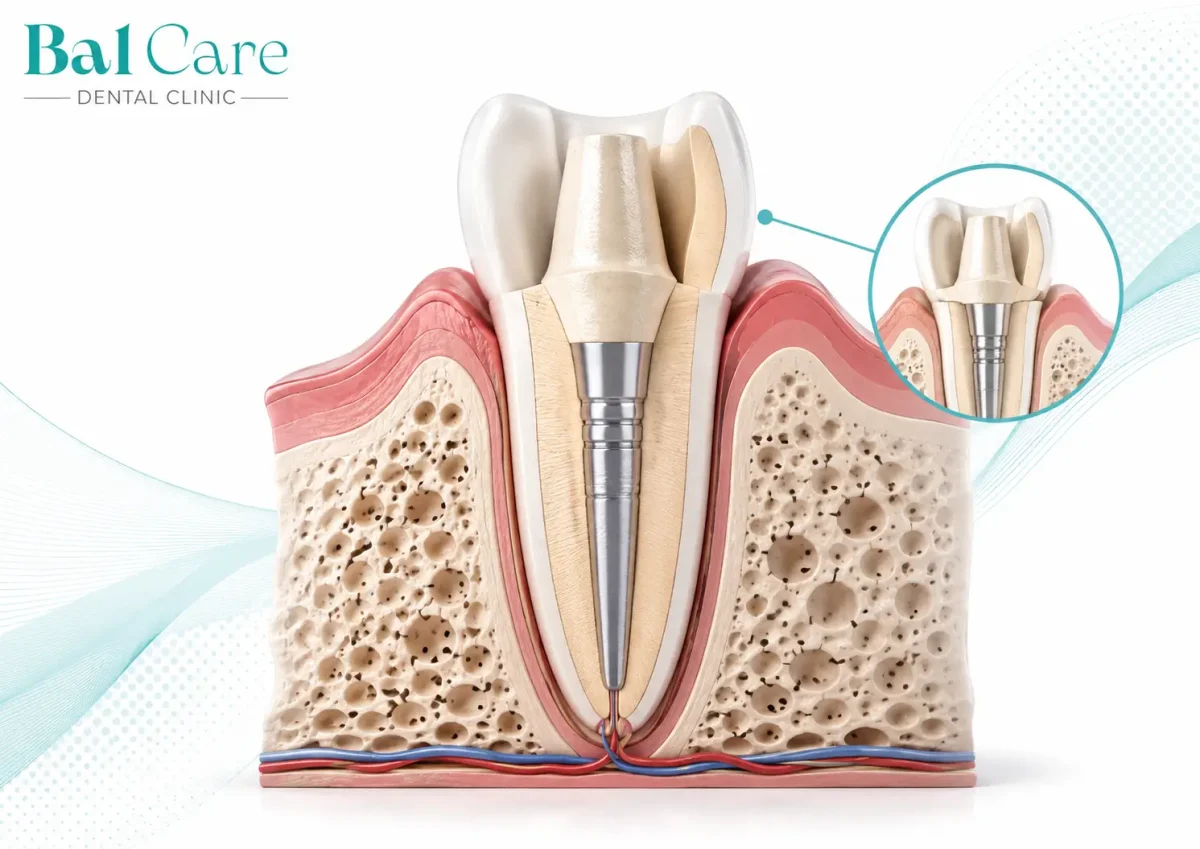

Dental Post and Core Restoration – When Is It Necessary and How Can It Help Preserve a Natural Tooth?
A severely damaged tooth does not always need to be extracted. When the root is stable, the root canal treatment has been performed successfully, and the tooth can be restored predictably, the natural tooth may be preserved with a post-and-core restoration and an appropriate dental crown.
A post-and-core restoration is used when a significant amount of tooth structure has been lost and a conventional filling cannot provide a sufficiently stable foundation. The aim is to restore the tooth’s shape, function, and natural appearance while preserving and using the existing root.
At BalCare Dental Clinic, the treatment decision is made after a detailed assessment of the root, the quality of the root canal treatment, the remaining tooth walls, the patient’s bite, and the functional forces that the tooth will need to withstand.
What Is a Post-and-Core Restoration?
A post-and-core restoration is a method used to rebuild a root canal-treated tooth when only a limited amount of the tooth remains above the gum line.
A dental post is secured inside the root canal, and a new core is built around it. This core provides a stable foundation for a dental crown or another suitable prosthetic restoration.
It is important for patients to understand the difference between the three main components:
The dental post is placed inside the root canal and provides retention for the core build-up.
The core build-up replaces the missing portion of the tooth above the gum line.
The crown covers the reconstructed core and restores the tooth’s shape, function, and appearance.
The dental post has a specific purpose – to retain the core when the remaining natural tooth structure is insufficient to provide a stable restoration on its own.
When Is a Dental Post and Core Recommended?
A post-and-core restoration may be recommended for teeth that have been significantly damaged as a result of deep decay, a large old filling, trauma, fracture, or previous root canal treatment.
Before treatment, the dentist evaluates:
- the quality of the root canal treatment;
- the length and shape of the root;
- the amount of healthy tooth structure remaining;
- the condition of the gums and supporting bone;
- the position of the tooth;
- the patient’s bite and chewing forces.
The need for a dental post is determined individually. Some root canal-treated teeth retain enough healthy tooth structure to be restored successfully using another type of restoration without an intraradicular post.
Does It Matter Which Tooth Is Being Restored?
Front and back teeth are exposed to different forces and have different anatomical characteristics.
For front teeth, a post-and-core restoration is often used to create a stable foundation while allowing the dentist to achieve a natural aesthetic result.
For premolars, careful assessment of the remaining tooth walls is particularly important because these teeth play an active role both in chewing and in guiding the bite.
For molars, the large internal portion of the tooth may sometimes provide sufficient retention for the core build-up and allow the tooth to be restored without a post. In selected cases, an endocrown may also be considered. An endocrown is a restoration that uses the internal portion of the tooth for retention and may allow a more conservative preservation of the remaining dental tissues.
What Types of Dental Posts Are Used?
The choice of dental post depends on the position and anatomy of the tooth, the amount of remaining tooth structure, and the type of final crown or restoration that is planned.
Fibre Post
A fibre post is made from a composite material reinforced with glass fibres. Its light colour makes it particularly suitable for aesthetic restorations and metal-free crowns.
It is combined with a composite core build-up and allows the restoration to be completed directly in the dental clinic.
Custom-Made Post and Core
When the root canal has a specific anatomy or when a significant part of the tooth crown has been destroyed, a custom-made post-and-core restoration may be fabricated in a dental laboratory.
The restoration is individually designed to match the anatomy of the specific tooth.
There is no single type of dental post that is ideal for every patient. The most appropriate solution is the one that best matches the individual clinical situation.
Why Is the Remaining Natural Tooth Structure So Important?
The success of the restoration depends not only on the dental post but, above all, on the amount and position of the healthy natural tooth structure that remains.
Of particular importance is the presence of a stable ring of natural tooth structure above the gum line that can be encircled by the future crown. This is known as the ferrule effect.
The ferrule effect helps distribute chewing forces more evenly and contributes to the long-term stability of the restored tooth.
When very little visible tooth structure remains, the dentist evaluates which restorative approach can provide the best support and long-term function.
What Results Can Be Expected?
A properly planned post-and-core restoration can help preserve the natural tooth root and restore:
- the normal shape of the tooth;
- its function during chewing;
- proper contact with neighbouring teeth;
- harmony of the bite;
- the natural appearance of the smile.
Once the final crown has been placed, the restored tooth becomes a natural-looking part of the dental arch. The colour and shape of the crown are selected to match the neighbouring teeth and the individual characteristics of the patient’s smile.
Dental Post or Dental Implant – What Is the Difference?
A dental post and a dental implant have different purposes and are not interchangeable treatments.
With a post-and-core restoration, the natural tooth root is preserved and used as the foundation for rebuilding the tooth. A post is placed inside the root canal, a core is built around it, and an appropriate crown is then placed over the restored tooth.
This option may be considered when the root is stable, the root canal treatment is satisfactory, and sufficient healthy tooth structure remains to allow predictable restoration.
A dental implant, on the other hand, replaces a missing tooth root. The implant is placed directly into the jawbone, and a dental crown is subsequently attached to it.
An implant may be an appropriate solution when the natural tooth cannot be preserved and restored with a favourable long-term prognosis.
When the natural tooth root is reliable, preserving it is generally the preferred treatment option. A dental implant is considered a way of restoring function and aesthetics when a natural tooth is missing.
Both approaches can provide excellent results when selected appropriately according to the condition of the tooth, bone, gums, and bite.
What Determines the Cost?
The cost of a dental post-and-core restoration is determined individually.
It depends on the condition of the tooth, the type of dental post required, the extent of the core build-up, and the type of final restoration selected.
For this reason, an exact treatment cost can be determined after a clinical examination and appropriate diagnostic imaging, when the dentist has all the necessary information about the individual case.
Frequently Asked Questions
Does Every Root Canal-Treated Tooth Need a Dental Post?
No. The need for a dental post depends on the amount of healthy tooth structure that remains. When sufficient natural tooth structure is available, the tooth may be restored without an intraradicular post.
Does a Dental Post Replace a Dental Implant?
No. A post-and-core restoration uses the patient’s existing natural tooth root. A dental implant replaces a missing tooth root and is placed directly into the jawbone.
Is a Dental Crown Always Necessary?
For significantly damaged teeth, a crown is often an important part of the overall restoration. Depending on the tooth and the amount of remaining healthy tissue, another type of restoration may sometimes be selected.
Is a Fibre Post Suitable for a Front Tooth?
Yes. Fibre posts are frequently used in the aesthetic zone because of their light colour and their compatibility with metal-free dental crowns.
How Long Can a Restored Tooth Last?
The longevity of a restored tooth varies from patient to patient and depends on the condition of the root, the amount of healthy tooth structure remaining, the patient’s bite, the quality of the complete restoration, and regular dental follow-up.
Individual Assessment at BalCare Dental Clinic
At BalCare Dental Clinic, every severely damaged tooth is assessed individually.
When necessary, magnification and a dental microscope are used to provide greater precision during treatment and to help preserve as much healthy natural tooth structure as possible.
The aim is to select a restorative solution that combines stability, function, and natural aesthetics.
Phone: +359 879 882 883
Email: info@balcare.bg
Address: 147B Aleksandar Stamboliyski Blvd., Sofia, Bulgaria
Website: balcare.bg
The information provided is for educational purposes only and does not replace an individual dental examination, diagnosis, or personalised treatment plan.
