


Types of Dental Implants – Which Option Is Best for Your Case?
Types of Dental Implants – Which Option Is Best for Your Case?
Dental implants are one of the most modern and reliable solutions for replacing missing teeth. They provide stability, a natural appearance, and full chewing function and can be used to replace one, several, or all missing teeth.
In this article, we will look at the main types of dental implant solutions, their role, how implant placement is performed, the advantages of each method, and how the most appropriate option is selected according to your individual needs.
You will also find practical information based on the experience of implant dentistry, together with advice on implant maintenance and long-term durability.
What Is a Dental Implant?
A dental implant is a small titanium screw that is surgically placed into the jawbone, where it functions as an artificial tooth root.
The implant becomes integrated with the surrounding bone through a process known as osseointegration, providing a stable foundation for a crown, bridge, or denture.
Modern technology allows implant-supported restorations to look and function very similarly to natural teeth.
With appropriate care, dental implants can remain functional for many years and may last a lifetime, while also helping preserve the jawbone and reduce bone atrophy.
What Are the Main Types of Dental Implant Solutions?
Today, there are several main types of implant-supported restorations. The most appropriate option depends on the number of missing teeth and the type of restoration required.
1. Single-Tooth Dental Implant
A single dental implant is used when only one tooth is missing.
The implant is placed in the position of the missing tooth root, and a dental crown is then attached to restore the shape and function of the natural tooth.
Advantages:
- restores chewing function and a natural appearance;
- helps preserve the surrounding bone;
- does not require preparation of healthy neighbouring teeth, unlike a conventional bridge;
- provides a long-term solution with excellent stability.
The procedure is usually performed under local anaesthesia, followed by a healing period of several months to allow the implant to integrate fully with the bone.
2. Implant-Supported Bridge
When two or more neighbouring teeth are missing, an implant-supported bridge may be an appropriate solution.
In this case, two or more dental implants provide stable support for a bridge replacing several missing teeth.
Advantages:
- allows several missing teeth to be restored at the same time;
- provides excellent stability and a natural appearance;
- helps preserve the jawbone and reduce bone atrophy;
- may require fewer implants than replacing every missing tooth individually.
This treatment can offer an excellent balance between function, stability, and cost-effectiveness.
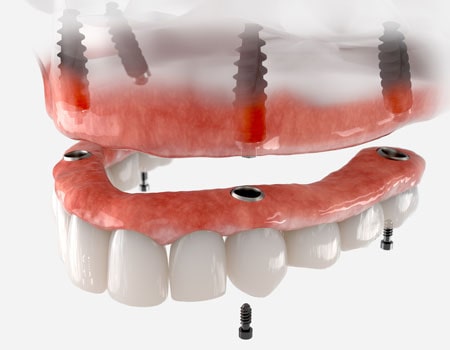
3. Full-Arch Implant-Supported Restoration
When all teeth are missing in one or both jaws, a full-arch implant-supported restoration may be the most appropriate solution.
In this type of treatment, usually four to six implants are placed to support a stable dental prosthesis.
These concepts are commonly known as All-on-4 or All-on-6, depending on the number of implants supporting the restoration.
Advantages:
- provides a fixed, stable, and aesthetic solution;
- allows comfortable eating;
- restores the smile and supports facial appearance;
- is particularly suitable for patients with complete tooth loss.
Modern full-arch implant-supported restorations can be made from zirconia or high-quality ceramic materials, providing durability, excellent aesthetics, and resistance to staining.
4. Implant-Retained Overdentures
An implant-retained overdenture is a removable denture that is stabilised on two to four implants using special attachments.
Advantages:
- provides significantly greater stability than a conventional removable denture;
- improves chewing comfort;
- may help reduce bone loss;
- offers a more affordable alternative to a fully fixed restoration.
This option is often preferred by patients who want greater security and comfort while still being able to remove the denture for cleaning.
Which Type of Dental Implant Treatment Is Right for You?
The choice of implant treatment depends on several factors, including:
- the number of missing teeth;
- the condition and volume of the jawbone;
- gum health;
- your general health;
- bite and functional requirements;
- individual expectations.
Your implant dentist will perform a comprehensive assessment using 3D imaging (CBCT) to evaluate bone volume and density.
If there is insufficient bone, bone grafting may be required before or during implant placement.
In most cases, an individual treatment plan is prepared, including implant placement, the final crown or prosthetic restoration, and monitoring of the healing process.
How Is Dental Implant Placement Performed?
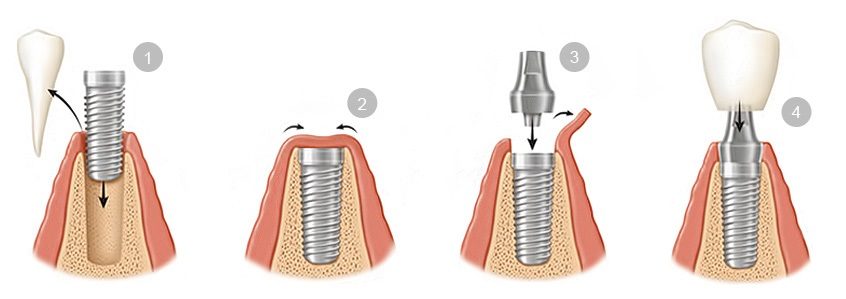
Implant treatment generally consists of several main stages:
Diagnosis and Treatment Planning
A clinical examination and 3D scan are performed to determine the precise position of the implant.
Implant Placement
The implant is surgically inserted into the jawbone. The procedure is performed under local anaesthesia and is designed to be comfortable for the patient.
Osseointegration
A healing period of approximately 3 to 6 months allows the implant to integrate with the surrounding bone.
Placement of the Abutment and Crown
During the final stage, the abutment and the visible prosthetic restoration are placed to restore the missing tooth.
Modern implant systems may also allow immediate loading in selected cases, meaning that the patient can receive a temporary fixed tooth or restoration on the same day.
What Are the Benefits of Dental Implants?
Dental implants do more than restore the appearance of the smile. They also support the health and function of the entire oral cavity.
They can:
- help prevent bone loss;
- support the natural contours of the face;
- improve speech and chewing;
- restore confidence and a natural-looking smile;
- avoid the need to prepare neighbouring healthy teeth.
According to data cited by the American Academy of Implant Dentistry, success rates for modern dental implants exceed 97%, making implant treatment one of the most reliable procedures in dentistry.
How Should You Care for Dental Implants?
Proper maintenance is essential for the long-term success of dental implants.
Follow these basic recommendations:
- maintain excellent oral hygiene and brush your teeth twice daily;
- use dental floss or interdental brushes;
- attend regular preventive dental examinations;
- avoid smoking, as it may reduce implant success and impair healing.
With appropriate care, dental implants can remain stable and functional for many years and, in suitable circumstances, may last a lifetime.
Your Smile Deserves the Best
Dental implants are one of the most reliable and aesthetic solutions for replacing missing teeth.
Whether you need a single dental implant, an implant-supported bridge, or a full-arch All-on-4 restoration, modern implant dentistry offers individual solutions for different clinical situations.
At BalCare Dental Clinic, we use modern technology, 3D diagnostics, and high-quality implant systems to restore your smile with maximum precision, stability, and a natural appearance.
