


How Long Does Treatment with Braces or Aligners Take, and Why Are Retainers So Important?
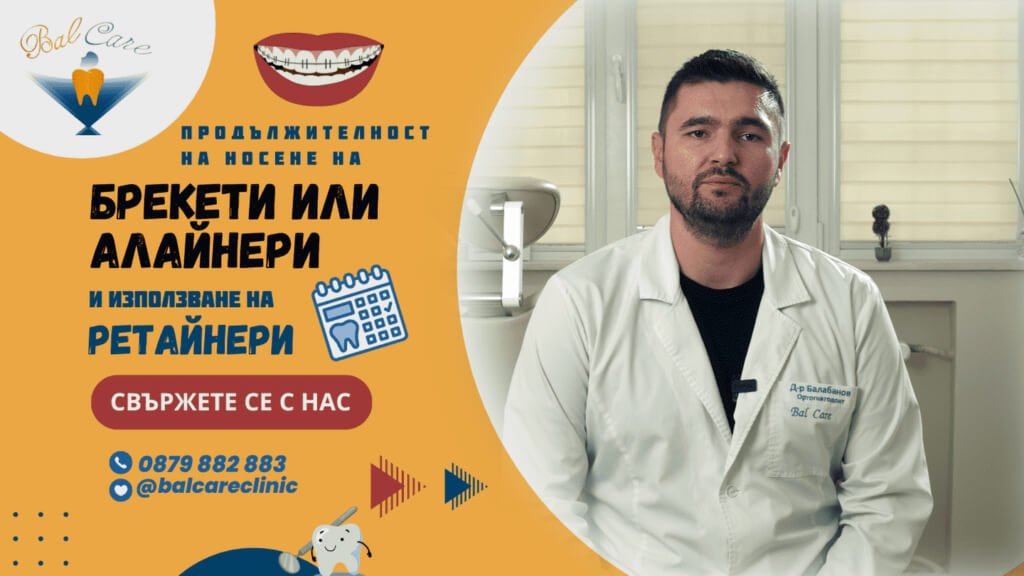
How Long Does Treatment with Braces or Aligners Take, and Why Are Retainers So Important?
If you are considering orthodontic treatment with braces or clear aligners, one of the first questions you are likely to ask is:
“How long will my treatment take?”
The duration of orthodontic treatment varies from patient to patient and depends on several factors, including:
- the complexity of the orthodontic problem;
- the amount and type of tooth movement required;
- the relationship between the upper and lower jaws;
- the treatment method;
- the patient’s individual biological response;
- how consistently the patient follows the orthodontist’s instructions.
In this article, we explain how long treatment with braces or clear aligners may take, what happens after active orthodontic treatment is completed, and why retainers are essential for maintaining the result.
At the end, you can also watch our video with Dr Trajko Balabanov from BalCare Dental Clinic, who explains the duration of orthodontic treatment and the important role of retention after braces or aligners.
How Long Does Treatment with Braces Take?
Orthodontic treatment with fixed braces commonly lasts approximately 18 to 36 months, although some cases may require less or more time.
The duration depends on the individual treatment plan.
Complexity of the Case
Simple alignment problems may be corrected relatively quickly, while more complex conditions can require substantially longer treatment.
These may include:
- severe crowding;
- significant spacing;
- crossbite;
- deep bite or open bite;
- impacted teeth;
- complex tooth movements;
- significant discrepancies between the upper and lower jaws.
The more extensive the correction required, the longer treatment may take.
Type of Braces
Different types of fixed orthodontic appliances are available, including conventional and self-ligating systems.
However, the type of bracket alone does not determine how quickly treatment will be completed.
The overall duration depends much more on:
- the diagnosis;
- treatment goals;
- biological tooth movement;
- appointment attendance;
- patient cooperation.
Age of the Patient
Orthodontic treatment can be successful in both teenagers and adults.
Growing patients may have an advantage when treatment involves modification of jaw growth, while adults can also achieve excellent tooth movement when the teeth and supporting tissues are healthy.
Age alone does not determine how quickly the teeth will move.
Patient Cooperation
Patient cooperation can have a major influence on treatment efficiency.
This includes:
- wearing orthodontic elastics as instructed;
- attending scheduled appointments;
- following appliance-care instructions;
- maintaining good oral hygiene;
- avoiding habits that repeatedly damage brackets or appliances.
Missed appointments or inconsistent use of elastics can extend the overall treatment time.
How Long Does Treatment with Clear Aligners Take?
Treatment with clear aligners varies considerably depending on the complexity of the case.
Some relatively simple cases may be completed within several months, while comprehensive treatment commonly takes around 12–18 months or longer.
More complex orthodontic problems may require a longer treatment period and additional refinement stages.
How Do Clear Aligners Work?
Clear aligners are a series of individually planned removable trays.
Each aligner produces small, controlled tooth movements and is replaced according to the schedule prescribed by the orthodontist.
Depending on the system and treatment plan, a new set of aligners may typically be introduced every one to two weeks.
For treatment to progress as planned, aligners generally need to be worn for most of the day and night, except when:
- eating;
- drinking anything other than water;
- brushing and cleaning the teeth.
One of the main advantages of aligners is that they are removable, making eating and daily oral hygiene easier.
However, this also means that successful treatment depends heavily on patient compliance.
Which Is Faster – Braces or Aligners?
There is no universal answer.
Clear aligners are not automatically faster than braces, and braces are not necessarily faster than aligners.
The most appropriate method depends on:
- the type of tooth movements required;
- the complexity of the bite;
- patient age and growth;
- treatment goals;
- patient cooperation.
The orthodontist will recommend the option most suitable for the individual case.
What Happens After Braces or Aligners Are Removed?
The end of active tooth movement does not mean that orthodontic treatment is completely finished.
After the teeth have reached their planned positions, they need to be stabilised.
Without appropriate retention, teeth may gradually move away from their corrected positions.
This is known as orthodontic relapse.
Why Do Teeth Move After Orthodontic Treatment?
During orthodontic treatment, the teeth move through the supporting bone.
After active treatment ends, the:
- periodontal ligament;
- bone;
- gingival and surrounding soft tissues;
need time to adapt to the new tooth positions.
In addition, teeth have a natural tendency to change position throughout life, even in people who have never undergone orthodontic treatment.
For this reason, retention is a fundamental part of orthodontic care.
Retainers – The Key to Maintaining Your Orthodontic Result
Retainers are orthodontic appliances designed to hold the teeth in their corrected positions after braces or aligner treatment.
They may be:
- fixed;
- removable;
- or, in many cases, a combination of both.
The appropriate retention strategy is determined individually by the orthodontist.
Types of Retainers
Fixed Retainers
A fixed retainer usually consists of a thin wire bonded to the back surfaces of the front teeth.
Because it remains permanently attached, it provides continuous retention without the patient needing to remember to put it in.
Fixed retainers are commonly used in areas that are particularly susceptible to relapse, especially the lower front teeth.
They require careful cleaning because plaque can accumulate around the wire.
Removable Retainers
Removable retainers may be made from:
- clear thermoplastic material;
- acrylic and wire;
- other orthodontic materials.
They are usually worn according to a schedule prescribed by the orthodontist.
After an initial period of more intensive use, many patients progress to night-time wear.
Their main advantage is that they can be removed for:
- eating;
- toothbrushing;
- cleaning the appliance.
However, their effectiveness depends on consistent use.
How Long Should Retainers Be Worn?
There is no single retention period that is appropriate for every patient.
In modern orthodontics, retention is often considered a long-term commitment.
Fixed Retainers
A fixed retainer may remain in place for many years and, in selected patients, indefinitely, provided that:
- it remains intact;
- oral hygiene is good;
- the teeth and gums remain healthy.
It should be checked regularly by a dentist or orthodontist.
Removable Retainers
The exact schedule depends on the case.
Patients may initially be asked to wear the retainer more frequently, followed by night-time use.
For many patients, continued night-time retention over the long term is recommended.
Do Retainers Need to Be Worn for Life?
In many cases, long-term or lifelong retention is the most predictable way to maintain tooth alignment.
This does not necessarily mean wearing a removable retainer every hour of every day.
After the initial retention period, the orthodontist may recommend wearing it only at night or on selected nights.
The important point is that teeth can continue to move throughout life.
What Happens If You Stop Wearing Your Retainer?
If removable retainers are not worn as recommended, the teeth may begin to shift.
Possible signs include:
- the retainer feeling tighter than usual;
- minor crowding returning;
- spaces beginning to reopen;
- changes in the alignment of the front teeth.
If your retainer suddenly feels very tight or no longer fits properly, do not force it into place.
Contact your orthodontist so that the position of the teeth and the condition of the retainer can be assessed.
How Should You Look After Your Teeth After Orthodontic Treatment?
Good maintenance is essential after braces or aligners are removed.
Wear Your Retainer as Recommended
Follow your orthodontist’s instructions regarding:
- how often to wear it;
- when to reduce the wearing schedule;
- how to clean it;
- when it should be checked or replaced.
Maintain Excellent Oral Hygiene
Continue brushing your teeth twice daily and cleaning between the teeth.
Patients with fixed retainers need to pay particular attention to cleaning around the bonded wire.
Depending on the position of the retainer, your dentist may recommend:
- interdental brushes;
- special floss;
- other appropriate cleaning aids.
Attend Regular Dental and Orthodontic Check-Ups
Routine appointments allow the dental team to monitor:
- tooth and gum health;
- the stability of the orthodontic result;
- fixed retainers;
- removable retainers;
- oral hygiene.
For many patients, a routine dental examination approximately every six months may be appropriate, although individual recommendations may vary.
Protect Your Retainer
Avoid habits that can damage a removable or fixed retainer, including:
- biting pens;
- chewing very hard objects;
- nail biting;
- exposing removable retainers to excessive heat.
A damaged retainer should be checked or replaced promptly.
How Should a Removable Retainer Be Cleaned?
A removable retainer should be cleaned regularly according to the instructions provided by your orthodontist.
In general:
- rinse it after removal;
- clean it gently with an appropriate brush;
- avoid very hot water, which may distort thermoplastic retainers;
- store it in its protective case when it is not being worn.
Do not wrap a retainer in a napkin while eating, as this is one of the easiest ways for it to be accidentally thrown away.
Why Is Retention Just as Important as Active Treatment?
Braces or aligners move the teeth into their planned positions.
Retainers help keep them there.
Without retention, months or years of orthodontic treatment can gradually be compromised by relapse.
This is why retention should not be viewed as an optional final step. It is an integral part of the orthodontic treatment plan.
Conclusion
Orthodontic treatment with braces or clear aligners requires time, consistency, and cooperation, but the result can provide long-term improvements in tooth alignment, bite, function, and smile aesthetics.
Treatment duration cannot be predicted solely from the type of appliance. Every patient requires an individual orthodontic assessment and treatment plan.
Once active treatment is completed, retainers play a crucial role in maintaining the corrected tooth positions.
At BalCare Dental Clinic, orthodontic treatment includes not only planning and active tooth movement, but also an individual retention strategy designed to help preserve the result over the long term.
If you are considering braces or clear aligners, or would like advice about your current retainer, our orthodontic team can assess your individual needs and recommend the most appropriate approach.
📞 Book an orthodontic consultation at BalCare Dental Clinic: +359879882883
Watch Our Video with Dr Trajko Balabanov
You can also watch our video with Dr Trajko Balabanov, where he explains how long orthodontic treatment with braces or aligners may take and why retainers are so important after treatment.
If you missed our previous episode about the different types of braces and clear aligners, you can also find it on the BalCare Dental Clinic YouTube channel and Facebook page.
Keep smiling with confidence – and remember that maintaining your orthodontic result is just as important as achieving it.
Ако сте пропуснали предишния ни епизод за ортодонтското лечение с различните видове брекети и алайнери, можете да го намерите в нашия YouTube канал или Facebook страницата ни. Последвайте ни за още полезни съвети и информация за денталното здраве.
За финал искаме да ви напомним да се усмихвате се с увереност, защото няма нищо по-красиво от усмихнат човек със здрави и правилно подредени зъби! 😊
