


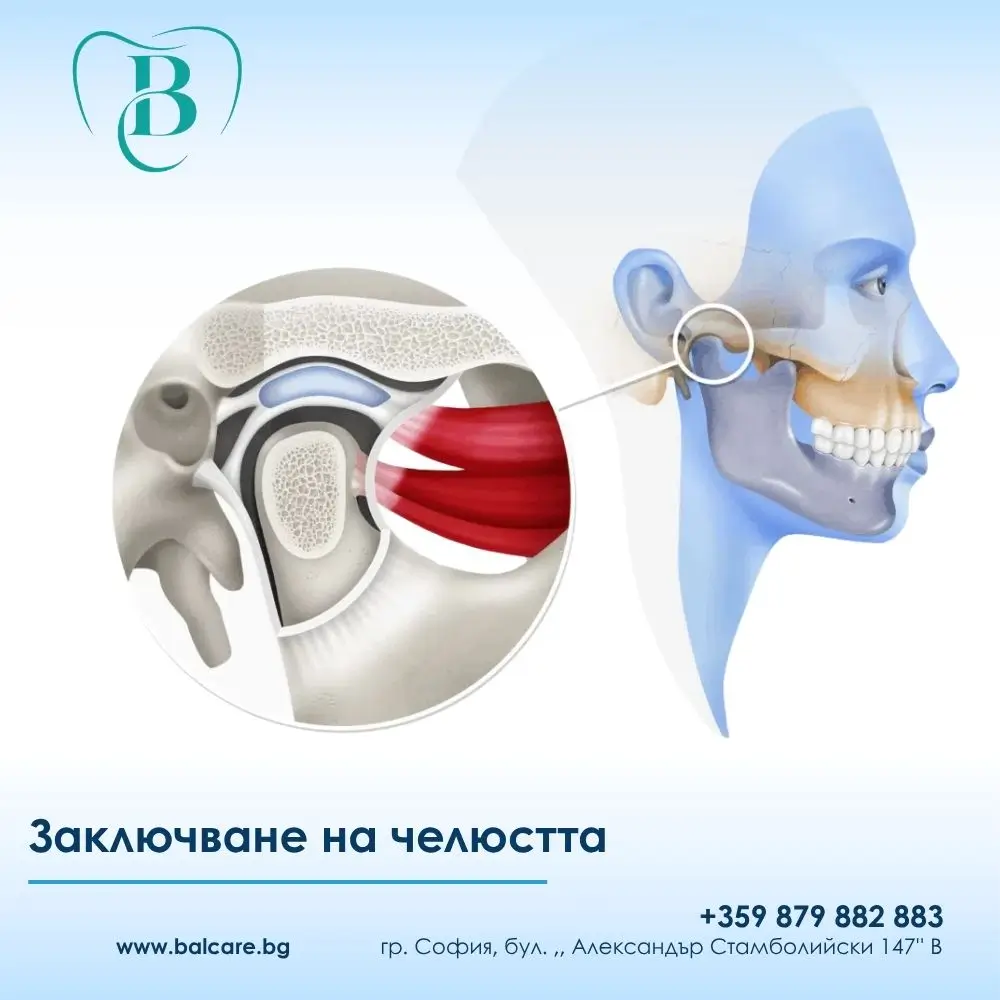
What Is Jaw Locking?
Jaw locking is a condition in which the lower jaw becomes fixed in a particular position – either open or closed.
In clinical practice, two main types are distinguished:
Closed lock (restricted mouth opening) – the more common condition, in which the patient has difficulty opening the mouth. Instead of the normal opening of approximately 40–50 mm (about 2 inches), the opening remains limited to around 20–25 mm (about 1 inch).
Open lock (inability to close the mouth) – a condition in which the patient is unable to close the mouth and bring the teeth together because of displacement within the temporomandibular joint.
How Does Jaw Locking with Restricted Opening (Closed Lock) Occur?
The articular disc is a flexible cartilaginous structure located between the joint surfaces of the temporomandibular joint. It helps ensure smooth, coordinated jaw movement and is stabilised by ligaments that keep it in the correct position.
In the presence of temporomandibular disorders, periodontal infections, or previous trauma, these ligaments may become damaged. This can increase the risk of disc displacement.
One of the first clinical signs of such a problem may be clicking or popping during jaw movement, indicating that the disc is no longer functioning normally.
Locking occurs when the disc fails to return to its normal position during movement. As a result, the lower jaw becomes “blocked” and its range of motion is restricted.
Although this condition is not among the most common temporomandibular disorders, in many cases it can be successfully managed when treatment is initiated promptly.
What Can You Do If Your Jaw Locks?
In the early stages, certain measures may help relieve the condition. However, it is important to emphasise that if the symptoms do not improve, consultation with a specialist experienced in temporomandibular joint (TMJ) disorders is essential.
Stay Calm
Stress and anxiety can cause the muscles around the jaw to contract even more, making restoration of normal movement more difficult.
For this reason, the patient should try to remain calm and avoid additional clenching of the jaw.
Apply Heat
Applying local heat to the jaw area for approximately 10–15 minutes may help relax the muscles and reduce spasm.
This can be repeated several times a day and is generally recommended before other techniques such as massage or gentle attempts to restore movement.
Massage the Masticatory Muscles
Gentle massage of the cheek area, just below the cheekbone, may improve local circulation and reduce muscle tension.
Using two or three fingers, perform gentle circular movements for several minutes.
Afterwards, the patient may carefully attempt a slight sideways movement of the jaw without using force.
Why Timely Treatment Matters
Clinical experience indicates that the greatest chance of restoring normal jaw movement is during the first days after locking occurs.
With timely treatment involving individually designed splints or orthotic appliances and specific therapeutic procedures, inflammation may be reduced and the normal range of motion may be restored.
As more time passes – particularly beyond 30 days – the likelihood of complete “unlocking” may decrease because structural changes can occur within the disc.
How Is a Locked Jaw Released?
The temporomandibular joint (TMJ) is the structure that allows movement of the lower jaw, with the articular disc playing an important role in this movement.
Jaw locking is a symptom of impaired function within this joint and may result in difficulty either opening or closing the mouth.
What Does Treatment for a Locked Jaw Involve?
Modern treatment is comprehensive and tailored to the individual clinical situation.
Treatment options may include:
- individually designed orthodontic or functional appliances;
- red light therapy (photobiomodulation);
- trigger point therapy;
- physiotherapy;
- injection therapies;
- botulinum toxin in selected cases, after inflammation has been brought under control.
What Happens After Jaw Movement Is Restored?
After normal movement has been restored, clicking or popping may reappear in the joint on the side that was previously locked.
This is a commonly observed phenomenon and indicates that the articular disc is once again participating in joint movement, although it may not always be in a completely stable position.
| Feature | Closed Lock (Restricted Opening) | Open Lock (Inability to Close) |
|---|---|---|
| Mechanism | Disc displacement without reduction | Dislocation of the mandibular condyle |
| What the patient experiences | Unable to open the mouth normally | Mouth remains open |
| Range of motion | Restricted (<30–35 mm) | Excessive and uncontrolled |
| Onset | Gradual or following previous clicking | Sudden, often after wide mouth opening |
| Subjective sensation | Tightness, blocking | Panic, inability to close the mouth |
| Clinical significance | Functional disorder | Condition requiring urgent intervention |
The Role of Myofascial Pain in Jaw Locking
In clinical practice, jaw locking is rarely an exclusively joint-related problem.
In a significant number of cases, it develops against a background of myofascial pain and chronic tension in the masticatory muscles, which may precede the actual locking of the joint.
The masticatory muscles – particularly the masseter and temporalis muscles – play an active role in stabilising and moving the lower jaw.
When these muscles are in a state of increased tone or spasm, they may alter the normal pathway of movement within the joint.
This can create uneven loading and contribute to conditions in which the articular disc becomes displaced.
In other words, muscular imbalance may be one of the factors that predisposes the joint to locking.
How Does the Myofascial Component Present?
Patients rarely associate these symptoms with the possibility of future jaw locking, but they can serve as early warning signs:
- a feeling of tension or “heaviness” in the jaw;
- facial or temple pain;
- morning stiffness;
- headaches without an obvious cause;
- teeth clenching or grinding;
- fatigue while chewing.
These symptoms are characteristic of myofascial pain syndrome, in which so-called trigger points develop within the muscles.
Trigger points are localised areas of increased sensitivity that can cause referred pain in different parts of the face and head.
The Relationship Between Muscle Tension and Jaw Locking
When myofascial pain remains untreated, it may lead to:
- altered coordination of jaw movement;
- increased loading of the temporomandibular joint;
- disc instability.
Over time, this may eventually reach a point at which the disc no longer returns to its normal position and the jaw becomes locked.
This transition is often accompanied by a previously described clinical sign – the disappearance of clicking followed by the development of restricted mouth opening.
Why Treatment Should Also Address the Muscular Component
When myofascial pain is present, treatment directed exclusively at the joint may not be sufficient.
An effective approach requires:
- reduction of excessive muscle tone;
- deactivation of trigger points;
- restoration of normal muscle function.
In this context, red light therapy (photobiomodulation) may be included as part of the therapeutic approach.
It may support the reduction of inflammation, improve local circulation, and help relax tense muscles.
This is particularly important because persistent muscular tension can maintain or aggravate joint dysfunction if it is not addressed.
What Happens If the Condition Is Left Untreated?
Without intervention, the body begins to adapt to the restricted movement.
Over time, this may lead to:
- persistent limitation of mouth opening;
- chronic pain;
- compensatory movements and asymmetry;
- worsening muscular imbalance.
The longer the condition remains untreated, the more limited the possibilities for complete functional recovery may become.
What Should Not Be Done?
One of the most common instincts is to try to “unlock” the jaw by force.
However, this may cause further damage.
When symptoms of jaw locking are present, sudden movements, very wide mouth opening, and excessive loading of the joint should be avoided until a professional examination has been performed.
Diagnosis and the Importance of Imaging
Clinical examination provides essential information, but when an intra-articular disorder is suspected, magnetic resonance imaging (MRI) may be used.
MRI allows assessment of the position of the articular disc and the condition of the soft tissues.
This information can be particularly important when planning treatment.
The Approach at BalCare Dental Clinic Is Strictly Individual and Depends on the Specific Case
At BalCare Dental Clinic, treatment does not focus only on the symptom but also on identifying the underlying cause of the dysfunction.
Management of jaw locking is based on a detailed functional assessment and an individually planned treatment strategy.
The approach includes functional analysis of the joint, assessment of muscular balance, and personalised treatment planning.
The goal is to restore normal movement while taking into account both the joint-related and muscular components of the condition.
The assessment focuses on:
- the condition of the masticatory muscles;
- the presence of trigger points;
- the degree of muscular imbalance;
- identifying the cause of the locking;
- distinguishing between muscular and joint-related components;
- restoring normal function.
Red light therapy may be used as part of this approach, particularly when muscular tension and inflammation are present.
👉 https://balcare.bg/red-light-therapy/
When Is a Consultation Necessary?
When mouth opening becomes restricted, pain develops in front of the ear, or there is a sensation of the jaw becoming blocked, early assessment by a clinician experienced in temporomandibular disorders is an important step towards restoring normal function.
Jaw locking is not simply a temporary inconvenience. It is the result of altered coordination within one of the most complex joint systems in the body.
Understanding the mechanism, recognising the symptoms early, and obtaining a timely diagnosis are essential for successful management.
The modern approach requires assessment not only of the joint itself but also of the overall function of the masticatory system – a principle that forms the basis of the approach at BalCare Dental Clinic.
Bibliography
- https://pmc.ncbi.nlm.nih.gov/articles/PMC4293719/
Disc displacement without reduction – a major mechanism involved in jaw locking - https://jcda.ca/article/e60
Conservative management of TMJ closed lock - https://pmc.ncbi.nlm.nih.gov/articles/PMC9737370/
Clinical study on the effectiveness of therapeutic approaches - https://www.sciencedirect.com/science/article/pii/S0901502725013980
Clinical characteristics of TMJ closed lock
