


Implant-Supported Dental Bridge
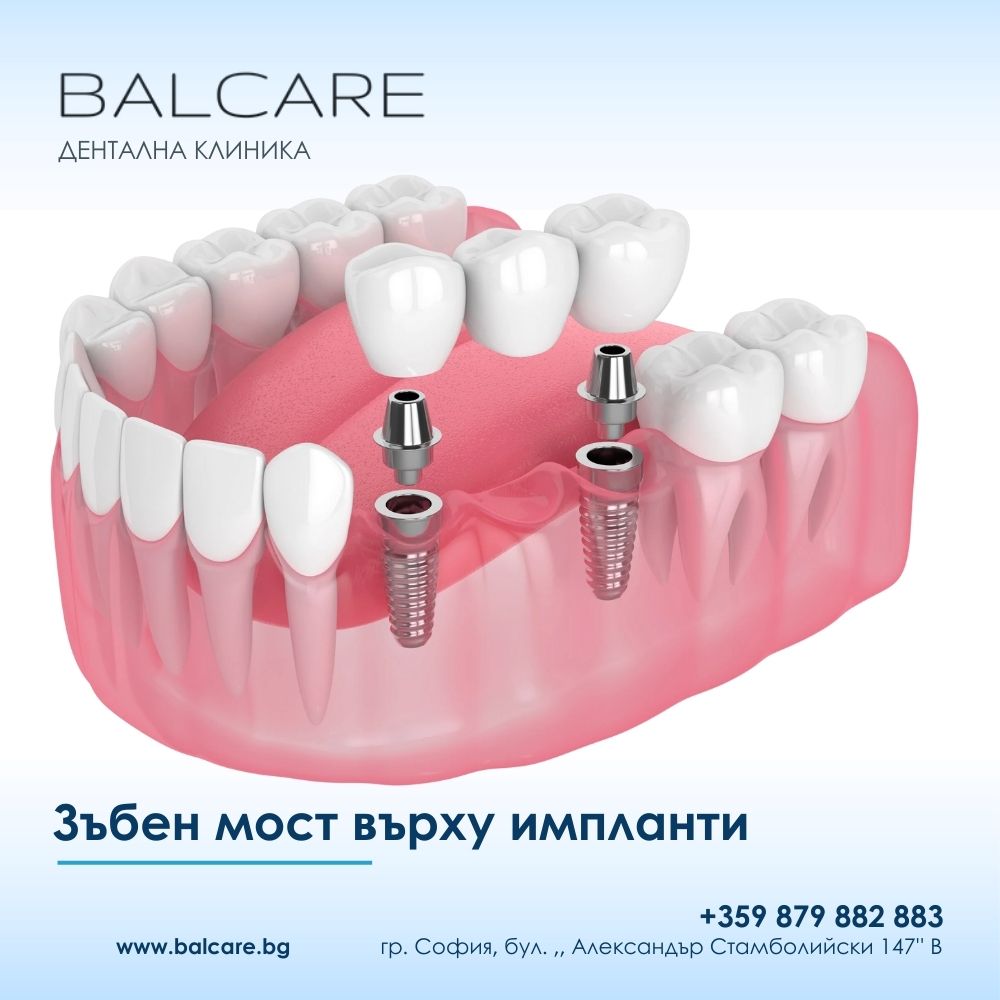
Implant-Supported Dental Bridge
Losing two or more adjacent teeth often leads to problems with chewing, aesthetics, speech, and self-confidence.
Modern implant dentistry offers a solution that is significantly closer to natural teeth than conventional bridges or removable dentures – the implant-supported dental bridge.
This treatment restores not only the missing teeth but also the biological balance of the jawbone and gums, providing stability, durability, and long-term function.
What Is an Implant-Supported Dental Bridge?
An implant-supported bridge is a fixed prosthetic restoration that replaces missing teeth by using dental implants as support.
Unlike conventional bridges, where healthy neighbouring teeth need to be prepared, an implant-supported bridge is an independent system supported entirely by dental implants.
In other words, the bridge replaces missing teeth without relying on reduced natural teeth for support.
Depending on the clinical situation, two implants may support three or four connected crowns in one stable restoration.
This makes the treatment:
- minimally invasive to neighbouring teeth;
- highly durable;
- biologically favourable;
- aesthetically precise.
What Are the Stages of Implant-Supported Bridge Treatment?
The placement of an implant-supported bridge involves several carefully planned stages designed to ensure high predictability and stability.
1. Initial Diagnostics and 3D Imaging
The first stage includes a 3D radiographic scan and a detailed assessment of the available bone.
The following are evaluated:
- available bone volume;
- spaces between the teeth;
- the position of the maxillary sinuses and nerves;
- the optimal positions for implant placement.
Treatment planning may also include the use of surgical guides to achieve maximum precision.
2. Implant Placement
The implants are placed under local anaesthesia and function as artificial tooth roots.
3. Osseointegration – Integration with the Bone
The healing and osseointegration period usually takes approximately 1–3 months when bone conditions are favourable.
If bone regeneration is required, the healing period may be longer.
4. Temporary Fixed Restoration, When Indicated
With immediate-loading protocols, the patient may receive a temporary fixed bridge within 24 hours.
5. Digital Impression
Once the implants have stabilised, a highly accurate digital impression is taken.
6. Fabrication and Placement of the Final Bridge
The final bridge may be made from:
- zirconia;
- ceramic;
- porcelain-fused-to-metal.
The restoration may be fixed using either screw retention or cementation, depending on the individual clinical situation.
Who Is an Implant-Supported Bridge Suitable For?
An implant-supported bridge may be appropriate:
✔ when two or more adjacent teeth are missing;
✔ when the patient wants to avoid preparation of healthy neighbouring teeth;
✔ in areas affected by bone loss where implants can provide stable support;
✔ when a more economical solution is preferred over replacing every missing tooth with a separate implant;
✔ when a larger missing-tooth area within one section of the jaw needs to be restored.
For patients with a completely edentulous jaw, full-arch treatment options may include:
- All-on-4;
- All-on-6.
Benefits of an Implant-Supported Bridge
1. Fixed Restoration and Excellent Stability
Dental implants stimulate the surrounding bone and provide highly stable support similar to natural tooth roots.
2. Long-Term Solution
Dental implants can function for decades, while the bridge is designed to withstand functional chewing forces.
3. Preservation of Healthy Teeth
Neighbouring teeth do not need to be reduced.
This is one of the major biological advantages compared with conventional dental bridges.
4. Protection Against Bone Loss
Implants provide functional stimulation to the bone and help reduce bone resorption in the area of missing teeth.
5. High-Level Aesthetics
Zirconia bridges can provide:
- a natural appearance;
- appropriate translucency;
- high strength;
- individually designed shape and colour.
Implant-Supported Bridge vs Conventional Dental Bridge
| Factor | Implant-Supported Bridge | Conventional Dental Bridge |
|---|---|---|
| Support | Dental implants | Prepared natural teeth |
| Healthy neighbouring teeth | No preparation required | Preparation required |
| Risk of decay in supporting teeth | No natural supporting teeth involved | Risk of caries in the supporting teeth |
| Bone resorption | Helps preserve bone | Bone resorption continues in the missing-tooth area |
| Longevity | 15–20+ years | 7–10 years |
| Aesthetics | Excellent | Good |
| Cost | Moderate | Moderate to lower |
Clinical Benefits of Implant-Supported Bridges
An implant-supported bridge is one of the few treatments that can restore function, aesthetics, and biological stability at the same time.
Preservation of Bone and Natural Facial Contours
After a tooth is lost, the bone in that area begins to resorb.
Dental implants restore some of the functional stimulation that natural tooth roots normally transfer to the surrounding bone.
This helps reduce:
- loss of bone volume;
- changes in gum contour;
- alteration of facial structure.
Maintaining bone volume may also reduce the need for more extensive bone augmentation procedures in the future.
Neighbouring Teeth Remain Intact
Conventional bridges usually require healthy teeth to be prepared in order to support the restoration.
This removes natural tooth structure and may increase the future risk of caries, fracture, or additional treatment.
Implant-supported bridges do not rely on neighbouring natural teeth.
The adjacent teeth remain untouched, which is one of the greatest biological advantages of this treatment.
Stability and High Survival Rates
Implant-supported bridges have demonstrated survival rates of more than 94% over a five-year period, and in many cases they continue to function successfully for 15–20 years or longer.
Their durability is supported by:
- stable implant anchorage;
- appropriate distribution of chewing forces;
- modern high-quality restorative materials.
Natural Aesthetics and Comfort
Zirconia bridges provide excellent strength while allowing a highly natural appearance.
The bridge can be carefully adapted to the surrounding gums and teeth to achieve a harmonious smile and stable function during speech and chewing.
Significant Improvement in Function
Patients can usually return to normal eating without the movement or instability associated with removable dentures.
Stable implant support allows more efficient chewing and improves everyday comfort.
Long-Term Financial Advantage
Although implant-supported treatment may initially appear more expensive, it may prove more economical over the long term.
An implant-supported bridge:
- usually does not require replacement as frequently;
- does not damage adjacent healthy teeth;
- helps preserve the bone;
- may reduce the need for repeated repairs or additional treatment.
Implant-Supported Bridge or Individual Implants – Which Is More Appropriate?
The choice depends primarily on the number and location of the missing teeth.
If only one tooth is missing, an individual dental implant is generally the preferred solution.
When two or more neighbouring teeth are missing, an implant-supported bridge may provide a more economical, stable, and predictable option.
Cost of an Implant-Supported Bridge at BalCare Dental Clinic
The cost depends on several clinical factors:
- the number of missing teeth;
- the number of implants required;
- the implant system used;
- whether bone regeneration is necessary;
- the material selected for the final bridge.
A simplified formula for estimating the treatment cost is:
Cost = (number of implants + surgical treatment) + cost of the crowns within the bridge
At BalCare Dental Clinic, the final cost is determined after a clinical examination, diagnostic analysis, and preparation of an individual treatment plan.
Frequently Asked Questions
What Is an Implant-Supported Bridge and When Is It Most Appropriate?
An implant-supported bridge is a fixed restoration that replaces missing teeth using dental implants for support rather than prepared natural teeth.
It is particularly suitable when several neighbouring teeth are missing in one area or when the patient prefers a stable but more economical alternative to placing a separate implant for every missing tooth.
Its main advantages are that healthy neighbouring teeth are preserved and bone loss in the missing-tooth area can be reduced.
How Many Implants Are Needed for One Bridge?
The number of implants is not fixed.
It depends on:
- the quality and volume of the bone;
- the location within the mouth;
- the number of teeth being replaced;
- chewing forces in the area.
In many situations, two implants may support a three- or four-unit bridge.
Larger missing-tooth areas may require additional implants to ensure long-term stability.
In smaller defects, the treatment approach is determined after careful clinical and digital planning.
Is the Procedure Painful?
Implant placement is performed under local anaesthesia, so the surgical procedure itself should not be painful.
Mild discomfort, pressure, or swelling may occur during the first few days after treatment, similar to the recovery following a tooth extraction.
This is generally expected and gradually subsides.
Many patients report that the procedure was considerably easier than they had anticipated.
How Long Does It Take to Complete an Implant-Supported Bridge?
The treatment time varies primarily according to how quickly the implants integrate with the bone.
When bone quality and volume are favourable, treatment may be completed within approximately 1–2 months.
If significant bone loss is present or bone regeneration is required, the treatment period becomes longer.
With immediate-loading protocols, however, a patient may receive a temporary fixed restoration within the first 24 hours, allowing greater comfort throughout the healing process.
Which Material Is Best for the Bridge?
The choice depends on the location of the restoration and the functional demands placed on it.
Zirconia offers high strength, durability, and excellent aesthetics and can be suitable for a wide range of cases.
Ceramic materials may be selected in highly aesthetic anterior areas, while porcelain-fused-to-metal restorations remain a more affordable option for certain larger bridges.
In our clinical practice, zirconia is frequently recommended because of its durability, biocompatibility, and aesthetic potential.
Can an Implant-Supported Bridge Look Natural?
Yes.
Modern CAD/CAM technology, zirconia, digital photography, and 3D scanning allow the bridge to be individually designed according to:
- shape;
- colour;
- translucency;
- the surrounding teeth and gums.
At BalCare Dental Clinic, digital technologies and modern laboratory techniques are used to achieve the most natural result possible.
How Long Does an Implant-Supported Bridge Last?
With excellent oral hygiene and regular preventive examinations, an implant-supported bridge may function for 15–20 years or longer.
The implants themselves can also remain stable for many years.
The most important factors for long-term success are:
- good daily oral hygiene;
- regular professional maintenance;
- appropriate bite control;
- routine follow-up appointments.
How Is an Implant-Supported Bridge Cleaned?
Maintenance is similar to caring for natural teeth but requires special attention beneath the bridge.
Recommended oral hygiene includes:
- brushing twice daily;
- interdental cleaning;
- special floss designed for bridges;
- oral irrigators when appropriate;
- regular professional cleaning at the dental clinic.
Cleaning beneath the bridge is particularly important to prevent plaque accumulation around the implants.
Can an Implant-Supported Bridge Be Used for a Completely Edentulous Jaw?
Yes.
For patients who have lost all of their teeth, fixed full-arch bridges may be supported using systems such as:
- All-on-4;
- All-on-6;
- Fast & Fixed.
These approaches allow an entire dental arch to be restored with a fixed prosthesis supported by a limited number of implants.
In selected cases, the patient may receive a fixed temporary restoration on the same day.
How Much Does an Implant-Supported Bridge Cost, and Why Is There No Standard Price?
The cost depends on many individual clinical factors, including:
- how many teeth are missing;
- how many implants are required;
- the restorative material;
- the amount of available bone;
- the implant system selected;
- whether additional procedures such as sinus lift or bone augmentation are necessary.
For this reason, an exact price can only be determined after a clinical examination and CBCT analysis.
At BalCare Dental Clinic, each patient receives an individual treatment plan designed to provide clarity, transparency, and predictability regarding the treatment stages and costs.
An implant-supported bridge is one of the most successful and durable options for replacing several missing teeth.
It combines biological stability, high-level aesthetics, and excellent chewing comfort.
At BalCare Dental Clinic, we use modern implant systems, precise digital diagnostics, and an individual treatment approach to provide comfortable and predictable long-term results.
